technology

FORGING Forging technology

What is forging?

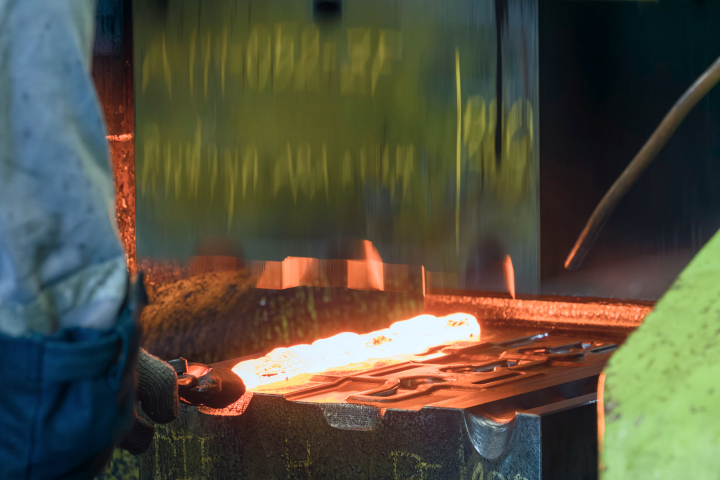
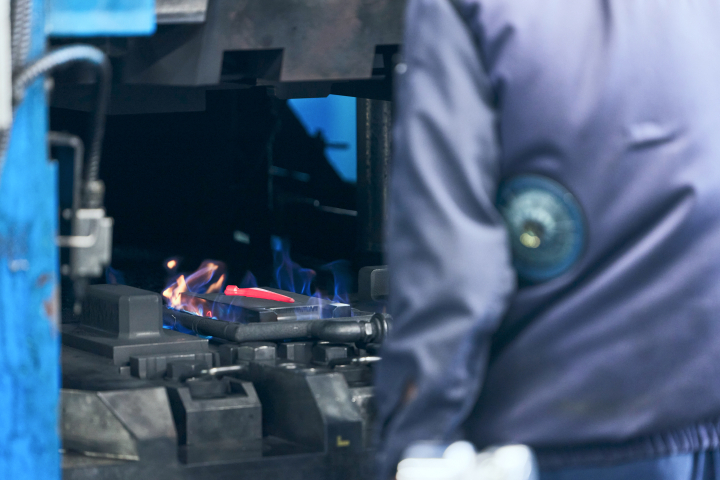
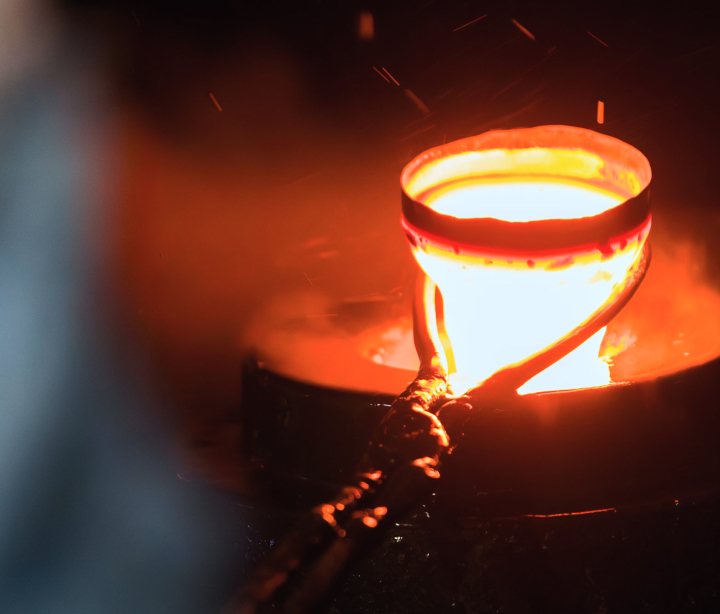
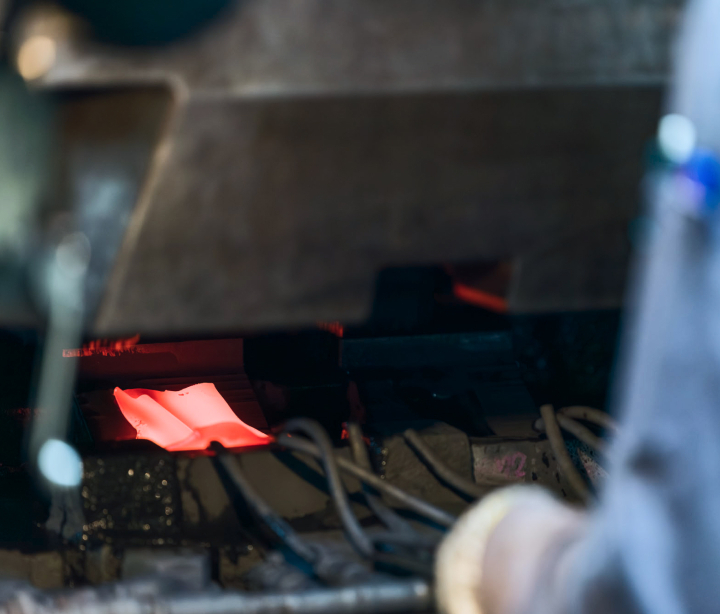
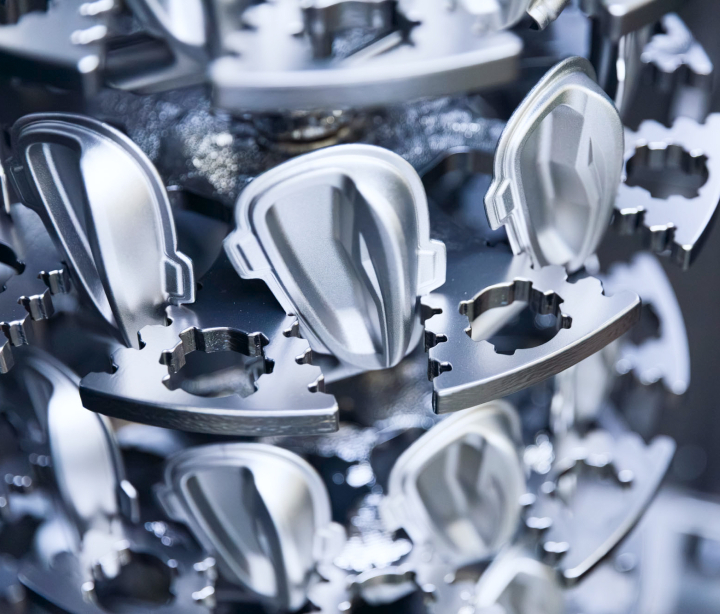
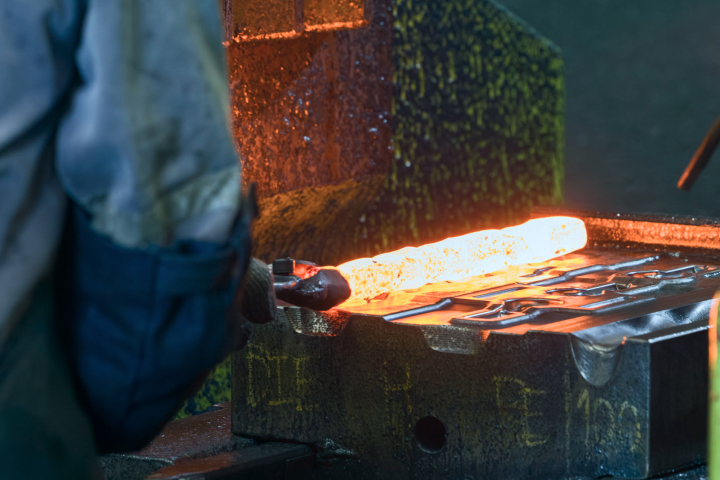
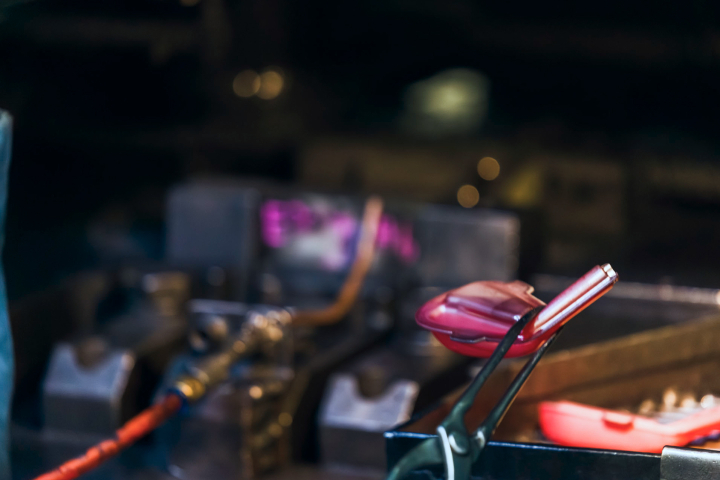
Forging is a processing method in which metal is heated and pressure is applied to form it into the desired shape. It was traditionally used in making swords and hoes, but today is widely used for manufacturing the precision parts that support the development of various industries, including for automobiles, aircraft, medical devices, and construction machinery.

The greatest benefit of the forging process is that the metallic structure is oriented in a fibrous manner along the processing direction, forming a forging flow line (fiber flow).
This forging flow line structure helps prevent the spread of internal defects and relieves stress concentrations as the crystal grain alignment is stretched by plastic deformation.

This makes it possible to produce high-reliability parts with superior tensile strength, fatigue strength, and toughness compared to cut or cast parts, and consistent performance in severe operating environments.

Why is forging technology
now in demand?

In recent years, as the development of electric vehicles (EVs), lighter and more advanced aircraft, and higher precision medical devices continues to advance, the requirements for manufactured parts have become increasingly sophisticated.

  • “Lighter and stronger”
  • “We want to handle complex shapes and difficult-to-process materials”
  • “We want to reduce costs and improve quality”

Forging is being utilized as a processing technology to meet these needs, such as net-shaping to reduce material loss by forging parts in a form close to that of the final product, and forging using lightweight but high-strength alloys.

Industries utilizing our forging technology

Automotive industry

Crankshafts, connecting rods, gears, wheel hubs, drive shafts

Aerospace industry

Engine parts

Medical device industry

Implants (artificial joints)

Railroad/shipping industry

High-strength large parts such as piston rods and hydraulic dampers

Energy industry

Turbine rotors, turbine blades, shafts, valves/hubs

Agricultural/industrial equipment industry

Axle/wheel hubs, blades, arm parts (excavators, lifts, etc.), hydraulic cylinder components

CORE Endo Manufacturing’s forging core technologies

Air hammer forging

We have extensive expertise in processing methods and processing equipment, including the in-house design/assembly and maintenance of air hammers. Nichia Forging (Japan) has a 16-ton air hammer, which is one of the largest in the industry. We can manufacture large parts such as turbine parts and railroad/construction machinery parts.

  • Our molds handle multiple processes, allowing us to process parts into finished product shapes.
  • The strength of the striking force can be controlled to create complex shapes.
Press forging
Processing is performed at a constant force and speed, allowing for mass production with consistent quality.
  • Net-shape forging parts in a shape close to that of the product saves time spent cutting and reduces costs.
  • The benefits of this kind of forging are greatest when working with expensive materials such as titanium alloys and cobalt-chromium alloys.

FORGING POSSIBILITIES What Endo Manufacturing’s forging technology can do for you

01.Lightweight and high-strength parts

Forging can both increase strength and reduce size. It can also help reduce the weight of subsequent parts.

02.Parts made from difficult-to-process materials

We can handle difficult-to-process materials such as titanium alloys and cobalt-chromium alloys. We have extensive experience manufacturing parts for the aircraft and medical industries.

03.Large and high-load part forgings

We can forge large parts using air hammers ranging in size from 3 to 16 tons. We have established a supply system for fields such as construction machinery, railroads, and energy.

04.Small-batch high-mix manufacturing

Our integrated in-house system covers everything from mold fabrication to forging, processing, and inspection. We can rapidly proceed from the initial prototype phase of development to mass production support.

05.Product launches with short delivery times

In-house fabrication of molds and jigs allows us to respond immediately to design changes and specification adjustments. We can also respond quickly to sudden mass production.

FEATURE Why choose Endo Manufacturing for forging?

For more than 70 years since our founding, Endo Manufacturing has continued to research and apply metal plastic forming technology, which supports the foundation of manufacturing.
Today, we provide high-precision/strength forged parts for a wide range of industries supporting society, including for automobiles, aircraft, construction machinery, medical devices, and railroads.

We will continue to work with our customers creating business growth together by leveraging our technologies, ability to propose solutions, and ability to ensure quality for customer product development and problem solving.
We are also happy to receive inquiries from the design conception stage.

01. Wide variety
of forging methods

We select the optimal forging method according to the shape, size, application, and material of the product.
We combine multiple methods, such as air hammer forging and press forging, to strike the best balance between quality, strength, production efficiency, and costs.

We also build flexible production systems to determine optimal solutions according to product characteristics. For example, we use a 16-ton air hammer (one of the largest in the industry) to handle large parts, and net-shaping to reduce material loss and reduce weight.

02. Support for a wide range
of materials

Temperature control technology tailored to material characteristics allows us to forge a wide variety of materials, including titanium alloys, cobalt-chromium alloys, and aluminum alloys. We are also capable of machining difficult-to-process materials used in the aircraft and medical device fields.

03. Complementary technologies
supporting forging

CAE analysis
(Simulation)
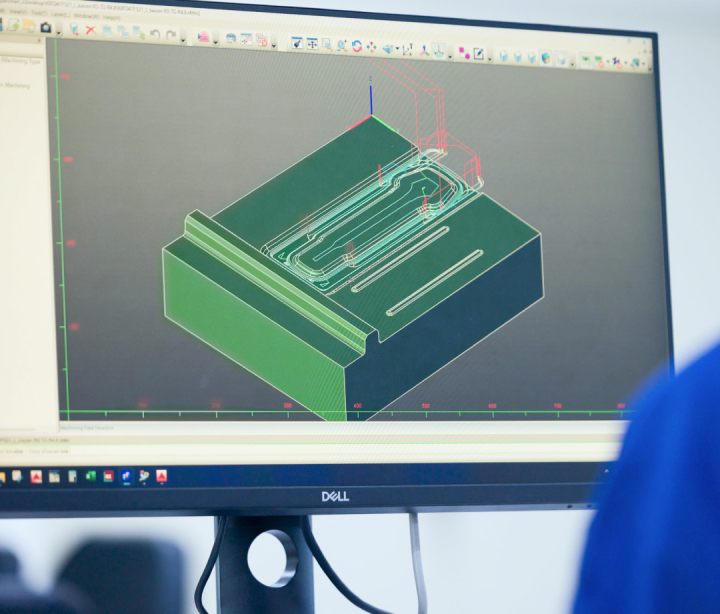
This technology visualizes material flow and stress/strain prior to molding, to predict defects and mold corrections in advance. This can increase the first-time prototype success rate, contributing to reducing costs and accelerating work.
Mold design/fabrication We provide integrated in-house services covering everything from design to fabrication, allowing us to reduce delivery time while accurately reflecting your design intent. We leverage our high-precision facilities and expertise to allow for the mass production of high-quality and high-repeatability molds for complex shapes.

04.Pre/post-processes
to support quality

01.Material procurement

We can procure materials from suppliers inside and outside Japan, allowing us to ensure a stable supply. Our material evaluation facilities allow us to provide products made of materials of guaranteed safety, particularly in the medical device and aircraft fields.

02.Shot, machining, polishing, and plating processes

We can handle a wide range of post-processes to meet the requirements of final products. Combining the latest facilities with craftsmanship, we can meet the high quality standards of the medical field.

03.Precision measurement/inspection systems

We are capable of 3D measurement, non-destructive testing with X-ray CT equipment, fluorescent penetrant testing, and microscope work. We are compliant with international quality requirements, and have obtained a wide range of certifications including AS9100 (Aerospace Business Office), IATF 16949 (ENDO FORGING), and ISO 13485 (Medical Devices Department).

METALSLEEVE Metal Sleeve technology (ultra-thin metal plastic forming technology)

Our 10-μm ultra-thin seamless pipes make the impossible possible

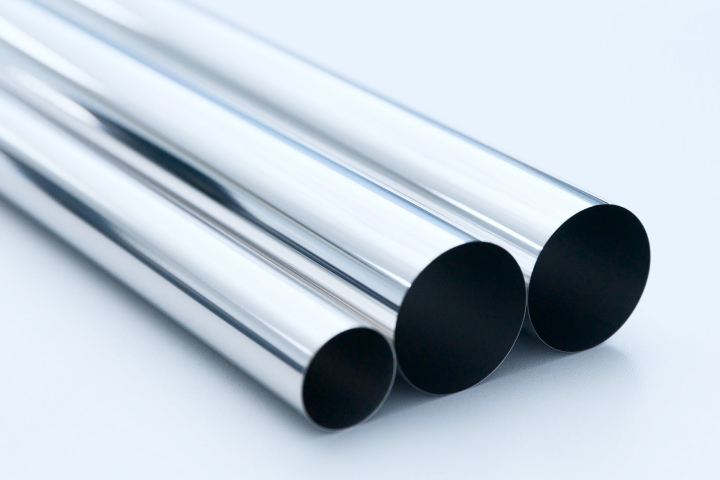
“Metal Sleeve” refers to our technology for processing 10-μm ultra-thin seamless metal pipes and the products produced using this process. Metal Sleeve is a unique technology that is the culmination of all of Endo Manufacturing’s metal plastic forming technologies.

Metal Sleeve products are manufactured by combining warm deep drawing with our unique spinning process, allowing for the mass production of high-precision ultra-thin pipes—a feat once thought impossible using conventional technology. The technology supports a variety of metals including stainless steel, steel, titanium, titanium alloys, nickel alloys, copper, brass, and clad materials.
We have patented the manufacturing method in Japan, the U.S., Germany, France, and the U.K., and are also aiming to expand use of the method globally.

Examples of products


Fuser rollers

Heating rollers

Battery cases

Motor covers

Seamless belts

Seamless rings

Motor parts

Drive belts

Electronic parts

Optical parts

ABOUT Metal Sleeve overview

Processing dimensions
Diameter 3 mm to 80 mm
Thickness From 0.025 mm
Total length Max. 400 mm
Surface roughness Ra ≤ 0.3 μm

The processing range for total length and thickness varies depending on the diameterVaries depending on product specifications as well. Please contact us for details.

Dimensional accuracy
Inner/outer diameter ±0.02 mm to 0.05 mm
Thickness From 0.025 mm, ±5% to 10%
Total length ±0.1 mm to 0.2 mm
Supported materials
Stainless steel SUS304, SUS305, SUS316L, SUS430, etc.
Titanium Pure titanium, beta titanium (Ti-15-3-3-3), 64 titanium (Ti-6Al-4V), etc.
Nickel alloys Pure nickel, Inconel 718, Inconel 625, permalloy, etc.
Others Metals exhibiting 10% or greater elongation, such as iron, copper, aluminum, and clad materials

Material can be selected according to properties, such as strength, corrosion resistance, thermal conductivity, and magnetic permeability

THERMAL METAL SLEEVE Metal Sleeve with high thermal conductivity

Clad material Metal Sleeve

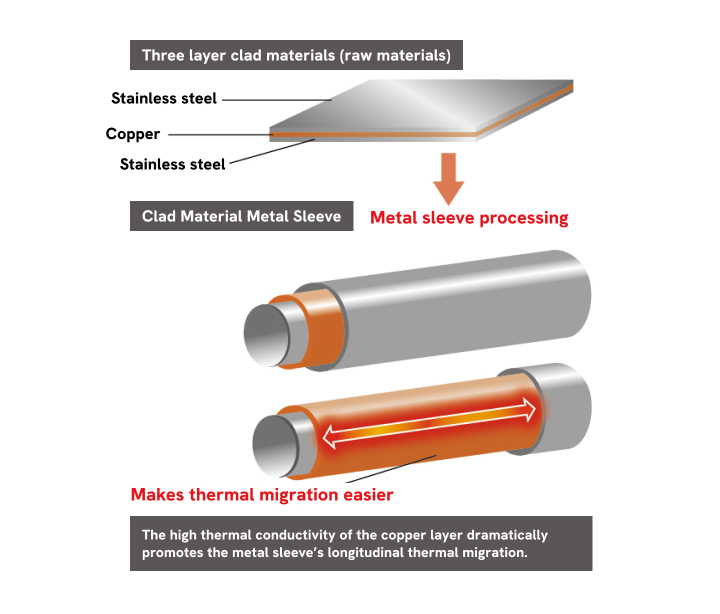
Clad materials made by pressure welding dissimilar metals are processed into ultra-thin seamless pipes using Metal Sleeve technology. For example, by processing a clad material consisting of three layers (stainless steel, copper, and stainless steel), an ultra-thin seamless pipe can be made that has both the strength of stainless steel and the thermal conductivity of copper.

Processing dimensions
  • Diameter: 18 mm to 45 mm
  • Thickness: 35 µm to 100 µm
  • Total length: 150 mm to 400 mm
Supported materials (examples) Stainless steel – Copper – Stainless steel
Stainless steel – Copper – Nickel, etc.

Laminated Metal Sleeve

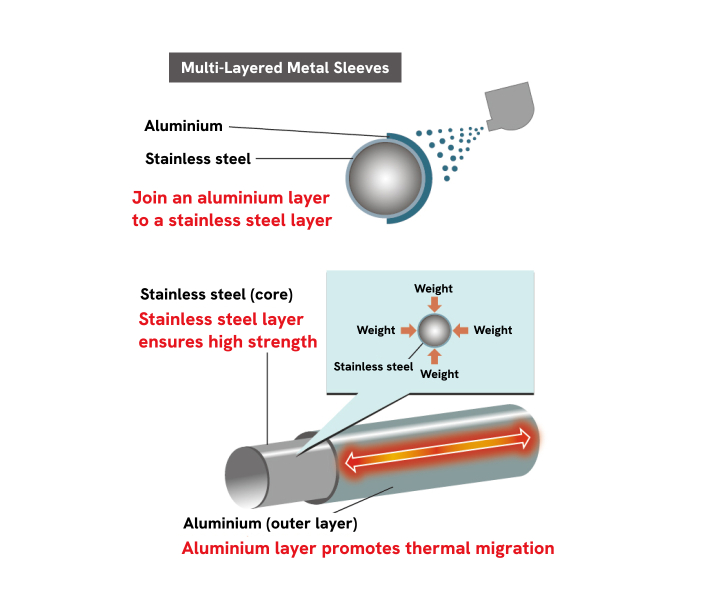
These products feature metal laminated on the surface of a thin seamless pipe processed using Metal Sleeve technology, according to the specific application. For example, aluminum material with high thermal conductivity is laminated on top of a thin seamless pipe made of strong stainless steel, resulting in a seamless pipe that has both the strength of stainless steel and the thermal conductivity of aluminum.

Processing dimensions

  • Diameter: 10 mm to 30 mm
  • Thickness: 100 μm to 300 μm
  • Total length: 150 mm to 400 mm
Supported materials (examples) Stainless steel – Aluminum
Pure iron – Aluminum, etc.

EXAMPLE Metal Sleeve processing examples

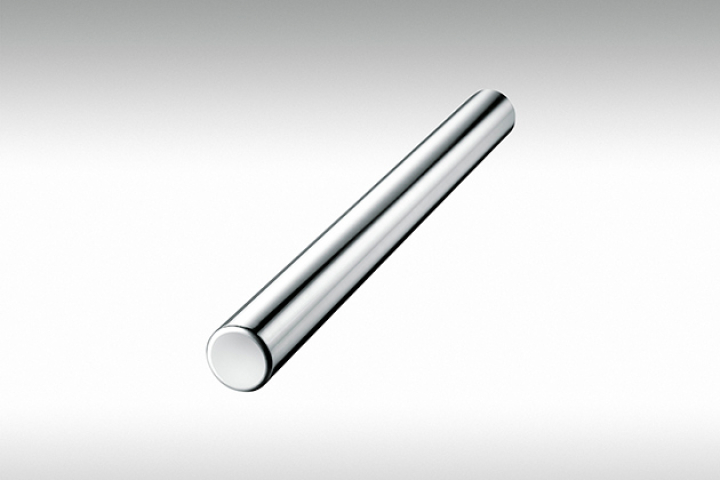
Ultra-thin seamless pipes
Our ultra-thin processing with a plate thickness of 40 μm or less results in sleeves that can be flexed like a resin film. They have excellent heat resistance, corrosion resistance, wear resistance, and rigidity.
Diameter φ18mm〜φ45mm
Thickness 27μm〜100μm
Total length 〜420mm


Thin seamless pipes
Our thin processing with a plate thickness of 100 μm or less does what no other production method can. These thin seamless pipes offer both thermal strength and corrosion resistance.
Diameter φ10mm〜φ30mm
Thickness 100μm〜300μm
Total length 〜420mm


Small-diameter ultra-thin seamless pipes
These seamless pipes are for applications requiring small diameters and thin products. We have also made seamless products from titanium (a difficult-to-process material), for use in electrical devices, medical devices, and automobile parts.
Diameter φ3mm〜φ10mm
Thickness 15μm〜100μm
Total length  〜400mm


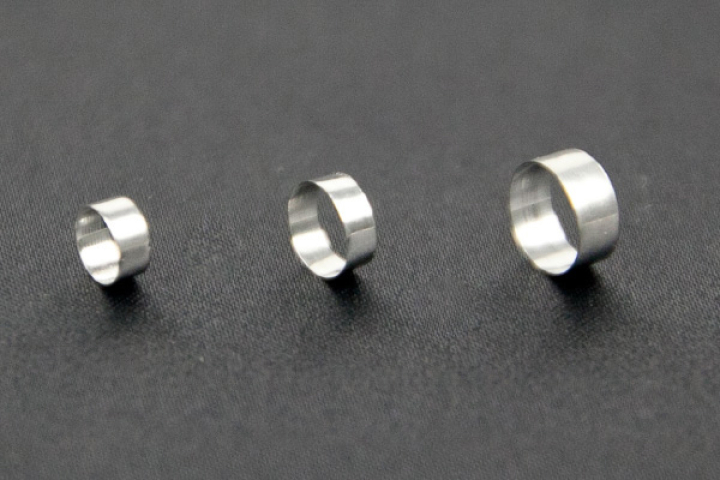
Small-diameter ultra-thin seamless rings
These seamless rings are for applications requiring small diameters and thin products. They are being developed as parts for medical devices.
Diameter φ3mm〜φ30mm
Thickness 15μm〜60μm
Total length 3mm〜


Ultra-thin seamless belts
These products offer excellent heat resistance and corrosion resistance, but also exhibit excellent properties as a base material for drive transmission belts due to their enhanced fatigue strength.
Diameter φ20mm〜φ160mm
Thickness 15μm〜60μm
Total length 3mm〜400mm


Bottomed seamless cases
These products have no welds between the bottom and cylindrical parts for excellent corrosion resistance, and exhibit excellent properties even in severe operating environments. They have been selected for possible use in battery cases.

Diameter φ20mm〜φ60mm
Thickness 50μm〜300μm
Total length 50mm〜400mm


CONTACT US Contact information

  • Considering products forged from difficult-to-process materials such as titanium or high-strength alloys?
  • Need a one-stop solution for large forged parts?
  • Want to solve cost and precision challenges by changing production methods?
We specialize in highly difficult forging, VA/VE proposals utilizing our extensive facilities, and OEM work

Endo Manufacturing participates in projects as a development partner proposing technologies, from the product development stage.
Endo Manufacturing proposes feasible solutions while utilizing our expertise and technologies, such as optimization of manufacturing methods, material conversion proposals, mold fabrication, mass production, cost cutting, and weight reduction.

CREATING A FUTURE WITHOUT LIMITS CREATING A FUTURE WITHOUT LIMITS